
· by Michael Blair, Nashville's Roofers
Once a roof claim is filed, the insurance company sends an adjuster, and that visit settles most of what the claim will pay. Homeowners usually come to it with two questions: what is the adjuster actually doing up there, and what is my roofer allowed to do about it. In Tennessee the answer to the second is narrower than many storm-season sales pitches suggest. This is how the visit works, where our role on insurance claim roofs begins and ends, and what the state’s own guidance tells you to do before and after.
Before the visit: hold the roof, not the repair
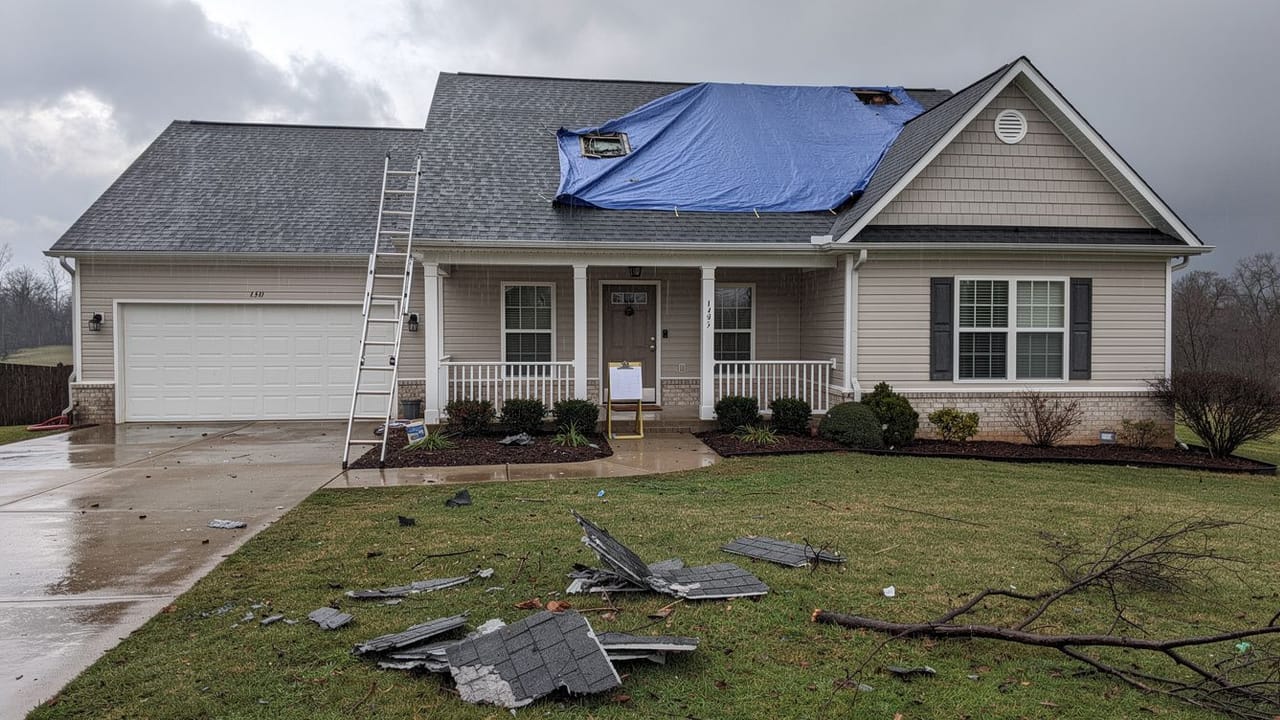
The first instinct after a storm is to get the roof fixed. Tennessee’s Department of Commerce and Insurance says to wait on that. Its consumer guidance on filing claims and selecting contractors tells homeowners not to have permanent repairs made until the insurance company has inspected the property, and to make temporary repairs that keep further damage from happening. On a roof that means a tarp over the opening, boards over a hole where a limb came through, and wet insulation pulled out of the attic. The National Association of Insurance Commissioners gives homeowners the same advice in its claims guide: cover the hole in the roof, board up the broken window, and keep the damage from spreading. It does not mean a crew tearing off the slope and putting new shingles down before anyone from the insurer has seen what was there.
Temporary work protects the house without erasing the evidence. A tarp can come off for the inspection; a finished re-roof cannot come back. Keep the receipts for whatever you buy or pay for in those first days, since the same guidance says to save them.
The department repeated the point in its 2024 release after Hurricane Helene: file as soon as you can, check your policy for the deadline to give notice, and hold off on permanent repairs until the insurer has inspected and you and the company agree on the cost. That release also lists what policies typically cover, including wind, wind-driven rain and damage from trees or other falling objects, which is most of what a spring storm in Middle Tennessee does to a roof.
What the adjuster is doing up there
The adjuster works for the insurance company. The job is to look at the roof, decide which damage came from a covered event, measure it and write an estimate the claim will be paid from. On a roof that usually means checking the slopes the storm hit, the soft metals like vents and flashing, and the shingles for the marks that separate storm damage from age. We wrote about those marks in telling hail damage from ordinary roof wear, and it is worth reading before the visit, because the adjuster is making exactly that call.
Whatever the adjuster writes down becomes the basis for the settlement. A slope that never gets looked at, or a vent that gets missed, is not in the number. That is the practical reason to be home for the visit, to walk the adjuster to the inside damage, and to have your own photographs ready. The state’s guidance also says to keep records of improvements made before the damage, so if the roof, the gutters or the decking were replaced a few years ago, have the invoice where you can find it.
- Photographs of the damage, outside and in, taken before any temporary repair
- Receipts for tarps, boards and emergency work
- Invoices for past roof or gutter work
- The policy, with the notice deadline marked
- A notebook for the date, the name and what was said
What a roofer can and cannot do for you
A roofer at the inspection is useful for one reason: we know what the roof needs and what it takes to put it back. Our crews can point to damage on the roof, explain how a repair or replacement on that roof is built, and price it line by line so the homeowner can compare our scope with the adjuster’s. That is the work we do on storm damage roofs, documented so an insurer can read it.
Negotiating the claim on your behalf is a different job with its own license. Tennessee’s public adjuster requirements say that no person or business may act or present themselves as a public adjuster unless licensed as one. A public adjuster is hired by the policyholder to represent the claim. A roofer who promises to handle the insurance company for you, settle the claim or get it approved is describing that role. Ask any roofer, us included, exactly what they will and will not do with your insurer, and get the answer before the visit, not after.
The claim stays yours. You file it, you talk to your insurance company, and you decide whether to accept what it offers. Our part is to make sure the roof is described accurately and the repair is priced honestly.
After the visit: the estimate, the money and the contract
When the estimate arrives, read it against the roof. The 2017 guidance says to ask the adjuster for an itemized explanation of the settlement offer, and to negotiate if the first offer seems low. Itemized is the word that matters. A line for each slope, the underlayment, the flashing, the vents and any decking lets you see what was counted and what was not. How the money is paid out, in one check or in two with depreciation held back, depends on the policy, and we covered that in ACV or RCV, and what your roof policy actually pays.
Keep the log going. The state’s guidance says to record each conversation with the insurance company: the date, who you spoke with and what was decided. If the claim seems to be handled unfairly or is denied and you believe it should not have been, the department’s insurance complaint page takes complaints for policies written in Tennessee and lists 615-741-2218 for questions.
Then hire the work the way you would any roof. The same 2017 release says never to pay more than one-third down and not to let payments get ahead of the work, to get a written contract, and to check the contractor’s license at verify.tn.gov. The Helene release adds a caution about door-to-door sellers who ask for money up front, which is the first thing most neighborhoods see after a hailstorm. When you have the adjuster’s estimate in hand, send it to us for a free estimate and we will walk the roof and tell you, line by line, where our scope and theirs agree and where they do not.
Sources
- National Association of Insurance Commissioners, Navigating the Claims Process: Recover and Rebuild — Mitigation: make temporary repairs such as covering holes in the roof or boarding up windows; the adjuster may want to see estimates before repairs.
- Tennessee Department of Commerce and Insurance, resource for consumers filing claims and selecting contractors (April 6, 2017) — Temporary repairs only until the insurer inspects; an itemized explanation of the settlement; records of prior improvements; a log of conversations; no more than one-third down; verify.tn.gov.
- Tennessee Department of Commerce and Insurance, filing claims and hiring contractors after Hurricane Helene (October 2, 2024) — File promptly; hold permanent repairs until inspected and agreed; what policies typically cover; caution with door-to-door sellers.
- Tennessee Department of Commerce and Insurance, Public Adjuster Requirements — No one may act or hold out as a public adjuster unless licensed as one.
- Tennessee Department of Commerce and Insurance, File an Insurance Complaint — Complaints about wrongly denied claims on policies written in Tennessee; phone for questions.