
· by Michael Blair, Nashville's Roofers
After a storm, the first number most people hear is the size of the hail, and the second is that anything under an inch does not hurt a roof. The first is useful. The second is not something the sources support. The one-inch figure is real, but it belongs to the weather service, and recent research on asphalt shingles suggests small hail matters more over the life of a roof than that rule implies. This is what the size does and does not tell you, and how it fits with the storm damage inspections we do across Franklin, Brentwood and Nashville.
Why does one inch matter to the weather service?
Because one inch, quarter size, is where the National Weather Service starts calling a thunderstorm severe. Its Instruction 10-512 defines a severe thunderstorm as one that produces hail one inch or larger, winds of 58 mph or more, or a tornado. That threshold was raised from three-quarters of an inch, penny size, to one inch at every NWS office on January 5, 2010, according to Service Change Notice 09-52.
That is a rule for when to issue a warning. Neither document says anything about what a given hailstone does to a roof, and the line moving by a quarter inch in 2010 did not change how shingles behave. When a neighbor says the storm was not severe so the roof is fine, the first half of that sentence comes from the weather service and the second half does not.
Is hail smaller than an inch harmless to a roof?
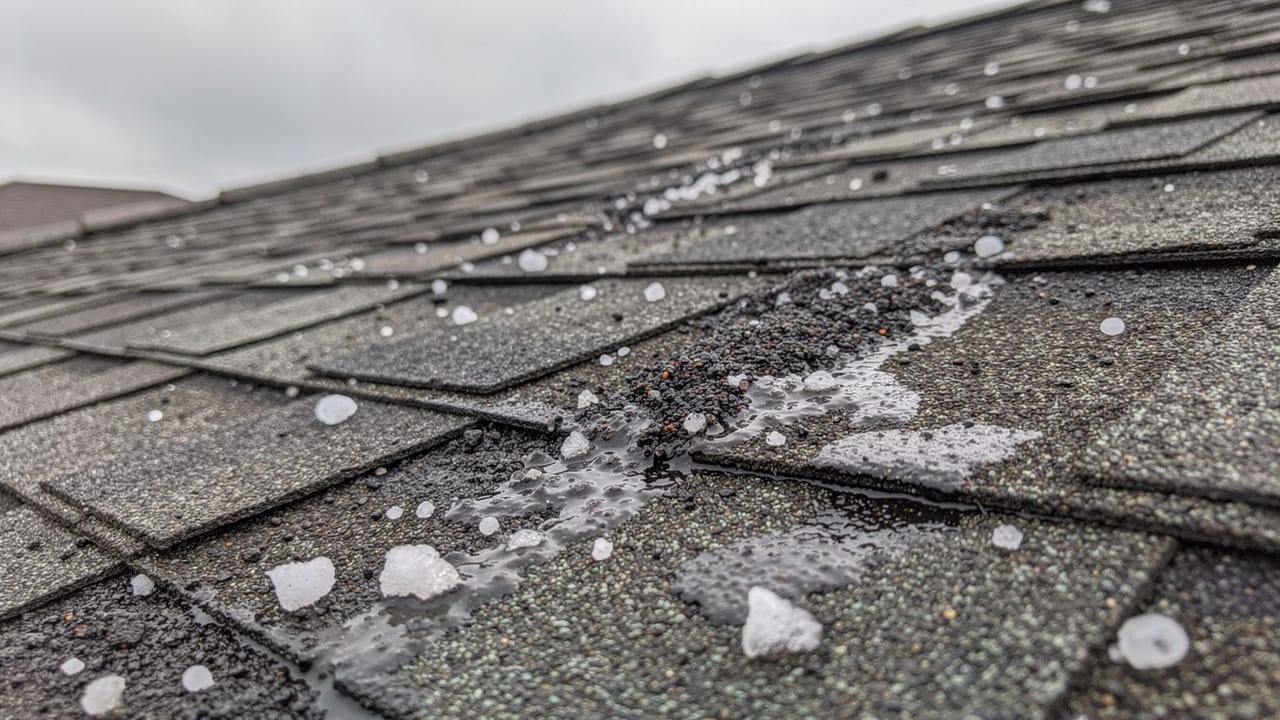
Not on the evidence of recent testing. In a 2025 paper in Frontiers in Materials, Sub-severe hail: the missing piece in assessing asphalt shingle risk, researchers at the Insurance Institute for Business & Home Safety hit six asphalt shingle products with ice spheres of 0.7 inch and 1 inch at a density of 44 impacts per square foot, which they chose from field data to represent a realistic small-hail event. They measured granule loss, and they call it a critical damage mode, because losing granules exposes the asphalt beneath to UV light, which makes it brittle and speeds its breakdown.
The paper reports that hail of one inch and below caused nearly 30 percent of the granule loss per stone that a two-inch hailstone did. The authors also note that the usual definition of functional, claim-worthy damage is a puncture or fracture that compromises water shedding or shortens service life, and that standard shingle testing looks at individual large impacts, not dense small ones. Their point is that small hail can wear a roof down without leaving the kind of break those tests look for.
Can a roof that looks fine still be hurt by hail?
It can be weakened, according to the same study, even when nothing is broken. The researchers weathered one set of shingles outdoors and kept a control set in conditioned storage, hit both with dense small hail after one year and again after a second, then struck everything with two-inch hail. Per stone, the weathered shingles that had taken small hail lost about 9.6 times as many granules as new shingles, while the conditioned set lost about 2.9 times as many. The authors summarize it as roughly ten times more susceptible to damage from later severe hail.
Their conclusion is that frequent small hail may threaten a roof’s life more than has been assumed, and that current durability standards do not account for it. It is one study of six products, and the authors present it as a gap in testing rather than a settled damage threshold. What it supports is a practical rule: an older roof that has been through several small storms is not in the same shape as a new one, even when the storms never made the news.
What to do after a storm
Use the reported size as a reason to look, not as a verdict. If you want to know what fell and when, the National Weather Service office in Nashville is the forecast office for Middle Tennessee and the place to start. Then have the roof looked at, because whether a storm hurt a particular roof depends on the shingle, its age and what it has already been through.
What a hit looks like up close, and how to tell it from ordinary wear, is in our post on hail damage versus roof wear. If the roof needs work, our roof repair service covers it, and if you want someone to look after the next storm, send us a note.
Sources
- Meisenzahl, Giammanco and Hedayati (IBHS), Sub-severe hail: the missing piece in assessing asphalt shingle risk in North America, Frontiers in Materials, 2025 — 0.7 and 1 inch ice spheres at 44 impacts per square foot on six products; granule loss as a damage mode; nearly 30 percent of the granule loss of a 2-inch stone; 9.6X and 2.9X damage multipliers in later 2-inch hail
- National Weather Service Instruction 10-512, Severe Weather Warnings (April 9, 2021) — A severe thunderstorm produces hail of 1 inch or larger, winds of 58 mph or more, or a tornado
- National Weather Service, Service Change Notice 09-52 — Severe hail criterion changed from 3/4 inch to 1 inch at all offices, effective January 5, 2010
- National Weather Service, Nashville office — The forecast office for Middle Tennessee
FAQ
What Size Hail Damages a Shingle Roof? — questions
What size hail damages a roof?
No source we found gives a single size. The National Weather Service uses one inch to define a severe storm, but that is a warning rule. A 2025 study found that dense hail of 0.7 and 1 inch removed granules from asphalt shingles, so the roof’s age and condition matter as much as the size.
Can small hail damage a roof?
It can wear one down. In 2025 testing, researchers at the Insurance Institute for Business & Home Safety found that hail of one inch and below caused nearly 30 percent of the granule loss per stone of a two-inch hailstone. Losing granules exposes the asphalt to UV light and speeds its aging.
Is quarter size hail enough to damage a roof?
It can be. Quarter size is one inch, the size at which the National Weather Service calls a storm severe. In the 2025 study we cite, dense one-inch and smaller hail knocked granules off shingles, and weathered shingles hit that way held up far worse in later large hail.
Can several small hailstorms add up to roof damage?
The 2025 research suggests so. Shingles weathered outdoors for two years and hit twice with small hail lost about ten times as many granules per stone in later two-inch hail as new shingles did. The authors say frequent small hail may shorten roof life more than assumed.
Why does the weather service call one inch hail severe?
It is the threshold the National Weather Service set for severe thunderstorm warnings, along with winds of 58 mph or more and tornadoes. Every NWS office moved the hail criterion from three-quarters of an inch to one inch on January 5, 2010. It is a warning rule, not a roof-damage rule.