
· by Michael Blair, Nashville's Roofers
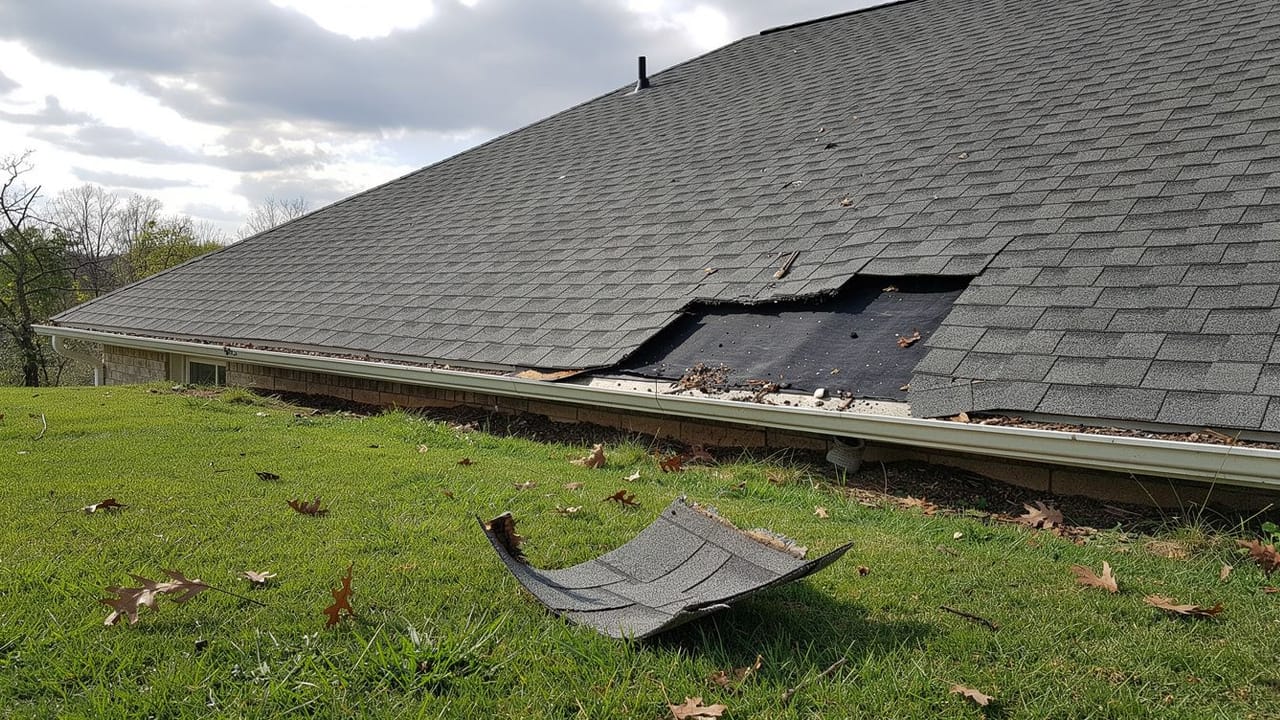
After a strong storm line comes through, the call usually starts the same way: there are shingles in the yard, and the roof looks fine from the driveway except for a dark patch or two. A few missing shingles feel like a small thing. The underlayment beneath them is not built to stand in the weather for long, though, and the shingles around the gap have often been lifted and creased even where they stayed put.
Why some shingles go and the rest stay has a plain answer, and it decides what the repair should be.
Why do shingles blow off a roof?
Shingles blow off when the wind gets under an edge that is not bonded to the course below. Every asphalt shingle carries a strip of sealant that the sun softens until it glues the shingle down. Owens Corning’s technical bulletin on cold weather shingle installation explains that the sealant is thermally activated, that the time it takes depends on slope, orientation and the outdoor temperature during and after installation, and that shingles put on in cold weather may not seal until warmer weather arrives.
Until that bond forms, a shingle is held only by its nails. The same is true of a shingle whose seal has let go with age, or one that was nailed in the wrong place. The Owens Corning Supreme installation instructions put the nails 5/8 inch above the tab cut-outs and below the adhesive strip, and warn that nails driven into the sealant strip keep it from bonding and add to blow-offs.
So the pattern in the yard tells us something. Shingles that came off along the rakes, the eaves and the ridge point to wind working at the edges. Shingles missing from a slope that sees little direct sun can point to a seal that never fully took, since orientation is one of the factors the bulletin names.
What wind rating does code require on shingles?
Code requires asphalt shingles to be tested and classified for wind, and the class has to match the design wind speed where the house stands. Section R905.2.4.1 of the 2024 International Residential Code as adopted in Nashville calls for testing to ASTM D7158, with the class printed on the packaging, and falls back to ASTM D3161 for shingles outside that standard’s scope. Its Table R905.2.4.1 accepts Class D, G or H under D7158 at the lower design wind speeds, and only Class H above 155 mph.
The same chapter sets the fastener floor in R905.2.6: the number the manufacturer’s instructions call for, and never fewer than four per strip shingle. Owens Corning’s Supreme instructions also list a six-nail pattern beside the standard four.
For a homeowner, this means the wrapper matters. When we replace shingles, the bundle label is where the wind class is stated, and it should match or exceed what the roof was built to.
Can you replace just the shingles that blew off?
Yes, a few missing shingles are usually a roof repair and not a new roof, as long as the shingles around them are sound and a match can be found. The work is more than sliding new pieces into the gap. The course above has to be lifted carefully to pull the old nails, each new shingle goes in on the manufacturer’s nail line, and the shingles we disturbed get their seal restored.
Owens Corning’s cold weather bulletin describes how that is done when the sealant cannot be counted on: four 1-inch dabs of asphalt roof cement under each architectural shingle, about an inch from the leading edge, and two dabs under each tab of a three-tab shingle, without letting the cement squeeze past the edge. In late fall and winter here, that hand sealing is what holds a repair until spring warms the strip.
If the decking shows through, it gets looked at too. The Department of Energy’s Building America Solution Center, in its guide to roof deck sheathing and sealed roof decks, describes sealing the deck as a second line of defense if roof covering blows off, and gives the FORTIFIED attachment for new decks as 8d ring-shank nails spaced 4 inches apart in the 4 feet nearest each edge and 6 inches apart everywhere else.
What we check after a windstorm
We start at the edges, because that is where the Insurance Institute for Business & Home Safety says the damage tends to begin. Its FORTIFIED Roof program describes wind getting under the roof edge and peeling it back, and reports that ring-shank nails nearly double a roof’s strength against that pull. So we check the drip edge, the starter course and the first rows of shingles along every rake and eave, then the ridge.
Next come the shingles that stayed. We lift a few on each slope to see whether the seal is bonded, torn or never formed, and look for creases across the shingles near the gap, which mean the wind folded them back. Where the roof is open, a tarp goes on first, as our post on emergency roof tarps explains, and a claim gets its photos through our storm damage work.
We work across the area, including roofing in Franklin. If you have shingles in the yard, send us a photo of the roof and the pieces, and tell us which side of the house they came from.
Sources
- Owens Corning, Technical Bulletin TB-10022497-A, Cold Weather Shingle Installation (April 2026) — Thermally activated sealant strip activated by the sun; activation time depends on location, slope, orientation and temperature; cold-weather shingles may not seal until warmer weather; hand sealing with four 1-inch dabs per laminate shingle and two per three-tab tab.
- Owens Corning, Supreme Shingles Installation Instructions — Fasteners 5/8 inch above the tab cut-outs and below the adhesive strip; fastening into the sealant strip contributes to blow-offs; four-nail standard and six-nail patterns.
- 2024 International Residential Code, Chapter 9 Roof Assemblies, as published for Nashville by UpCodes — R905.2.4.1 wind resistance: ASTM D7158 with class on the packaging, ASTM D3161 as the alternative; Table R905.2.4.1 classes by design wind speed; R905.2.6 fasteners per manufacturer, not fewer than four per strip shingle (third-party code viewer).
- Building America Solution Center (U.S. DOE / PNNL), Roof Deck Sheathing and Sealing for Sloped Roofs — Sealed deck as a second line of defense if roof covering blows off; three IBHS-allowed sealing methods; 8d ring-shank deck nails at 4 inches on center within 4 feet of edges and 6 inches elsewhere.
- Insurance Institute for Business & Home Safety, FORTIFIED Roof — Damage begins when wind gets under the roof edge; ring-shank nails nearly double roof strength against wind; sealed decks reduce water intrusion by up to 95 percent.
FAQ
Shingles Blown Off in a Storm: Why, and What Next — questions
What holds a shingle down in high wind?
Two things: the nails, placed on the manufacturer’s nail line below the sealant strip, and the bond the factory sealant forms with the course below once the sun has warmed it. A shingle whose seal never formed or has let go is held by its nails alone, and wind can lift its edge.
Do new shingles seal in cold weather?
Not right away. Owens Corning says shingles installed at or below 40°F may not seal until warmer temperatures activate the sealant. For that period it recommends hand sealing: four 1-inch dabs of asphalt roof cement under each architectural shingle, two under each tab of a three-tab shingle, near the leading edge.
What is a Class H shingle?
Class H is the highest wind classification under ASTM D7158, the test the International Residential Code names for asphalt shingles. In the 2024 code’s Table R905.2.4.1, Class D, G or H is accepted at lower design wind speeds, and only Class H is accepted above 155 mph. The class is printed on the bundle.
Where do roofs usually start to fail in wind?
At the edges. The FORTIFIED Roof program from the Insurance Institute for Business & Home Safety describes damage starting when wind gets under the roof edge and begins pulling it away. That is why the rakes, eaves and ridge are the first places we look after a storm, and where missing shingles most often show up.
Is a sealed roof deck worth it?
It is worth asking about on a reroof. A sealed deck, with taped seams or a full self-adhered membrane, keeps rain out if shingles blow off; IBHS says it can cut water intrusion by up to 95 percent. It does not keep shingles on, so the nailing and sealing still have to be right.